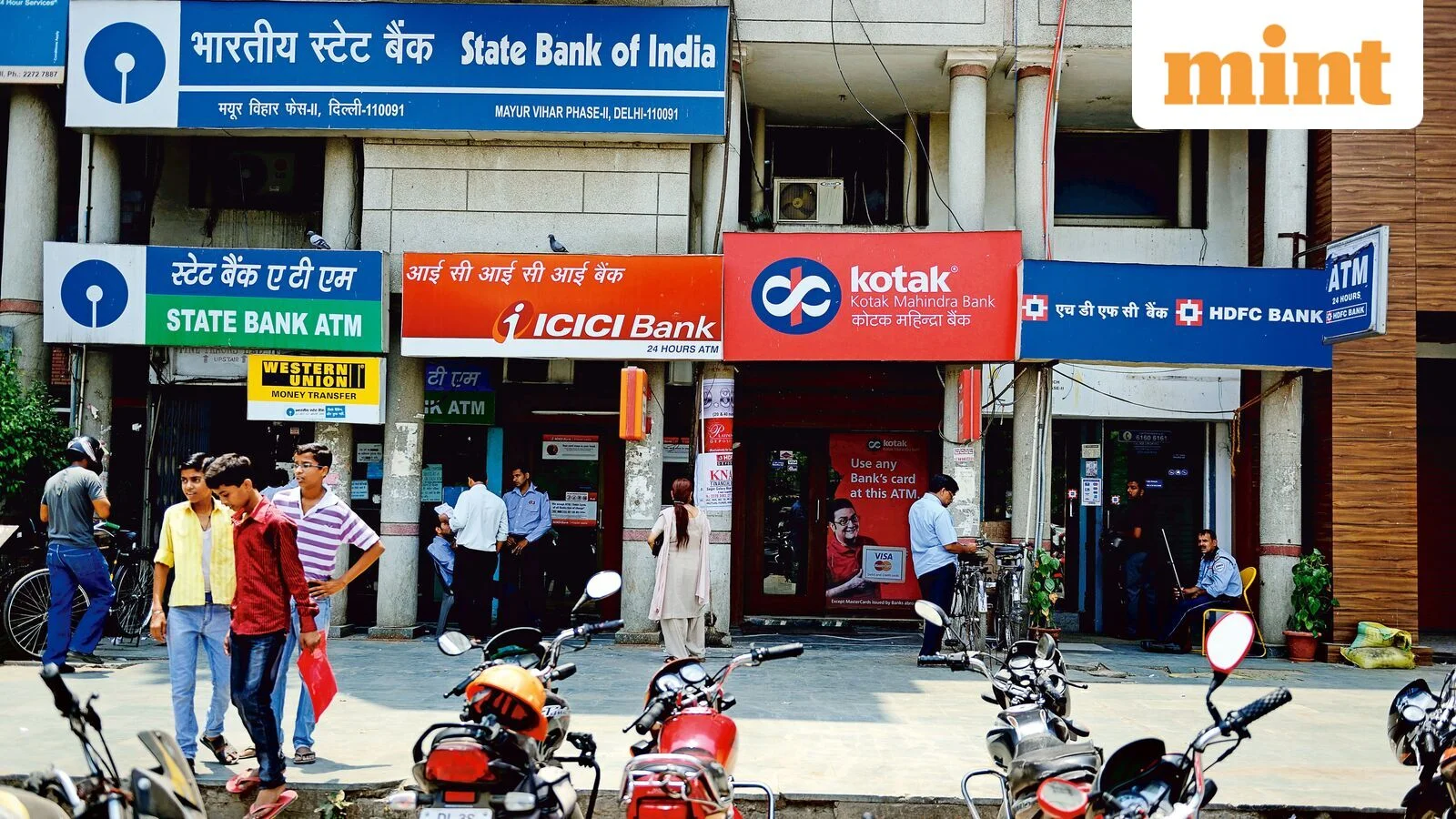
EAC-PM calls for fewer, equal-sized banks
New Delhi: India should make efforts to consolidate banks in such a manner that a few big banks of equal size are created without compromising the competition, said the Economic Advisory Council to the Prime Minister (EAC-PM).
“Though the concentration in the Indian banking industry is low, the market share of the banks varies significantly, starting from 20% to below 1%,” said the paper titled Reforms, Efficiency, and Productivity of Indian Banking Sector in the Last Decade: A DEA Approach, released on Tuesday night.
India’s banking sector remains diverse despite consolidation among public sector banks (PSBs). As of March 2026, the country had 124 scheduled commercial banks. PSBs accounted for 53% of banking offices, 64% of ATMs, 56% of deposits and 53% of credit. State Bank of India alone held 22% of deposits and 20% of credit, while the other 11 PSBs together accounted for 33% and 30%, respectively.
Private sector banks, numbering 21, accounted for 35% of deposits and 39% of credit. Foreign banks, numbering 44, accounted for 5% of deposits and 3% of credit. The banking system also comprises 11 small finance banks, 28 regional rural banks, four payment banks, and four local area banks.
Efficiency assessment
The recommendation comes alongside the paper’s assessment of banks’ efficiency and scale. It examined 47 banks between FY15 and FY26 using Data Envelopment Analysis (DEA), comprising 12 PSBs, 21 private banks and 14 foreign banks. The sample represented more than 95% of the banking system’s assets.
The analysis found that the mean technical efficiency of scheduled commercial banks was 91.29% in FY15, fell to 77.99% in FY20, then recovered to 88.59% in FY23 and 88.34% in FY26. Over the full FY15-FY26 period, the banking industry operated at an overall technical efficiency level of 87.7%, implying that inputs could theoretically be reduced by 12.3% while producing the same level of output.
PSBs recorded technical efficiency of 93.12% in FY26, compared with 86.02% for private banks, while foreign banks remained in the 83-85% range during FY20-FY26. The paper also found that PSBs outperformed private banks, particularly during the last three years of the study, FY24-FY26.
SBI recorded a technical-efficiency score of 97.49% over FY15-FY26, followed by Bank of Maharashtra at 90.49% among PSBs. Among private banks, HDFC Bank scored 97.54%, followed by IDBI Bank at 96.51%. Among foreign banks, HSBC and J.P. Morgan scored 1 in technical efficiency. In FY26, 15 of the 47 banks studied were technically efficient, with a score of 1.
The study, however, found greater variation in scale efficiency. Only seven of the 47 banks were scale-efficient in FY26, compared with 21 in FY15. The mean scale-efficiency score declined to 82.86% in FY20 but improved to 95.50% in FY26. SBI recorded 97.49% scale efficiency over FY15-FY26, followed by Punjab National Bank at 94.55%. Among private banks, HDFC Bank scored 97.54%, while IndusInd Bank scored 97.68%.
Strong growth
The EAC-PM paper also pointed to strong growth in banking activity. Scheduled commercial bank credit growth reached 19.3% in July 2026, while deposit growth stood at 15.4%, compared with 9% and 10.7%, respectively, in FY15.
At the same time, asset quality and capital buffers have improved. Gross non-performing asset (NPA) ratio declined to 1.68% in June 2026 from 11.5% at the end of March 2018. Aggregate Capital to Risk-Weighted Assets Ratio stood at 17.78% at the end of June 2026, compared with 13% in March 2013, while the Liquidity Coverage Ratio stood at 126.94%. Return on asset and return on equity were 1.32% and 13.23%, respectively, in June 2026.
The paper also found continued technological improvement. The frontier-shift score for scheduled commercial banks improved to 1.0087 in FY26 after declining to 0.7634 in FY23. It said that artificial intelligence and machine learning would drive further innovation in banking, with the system moving towards cognitive banking and greater use of AI-enabled capabilities across business functions.


