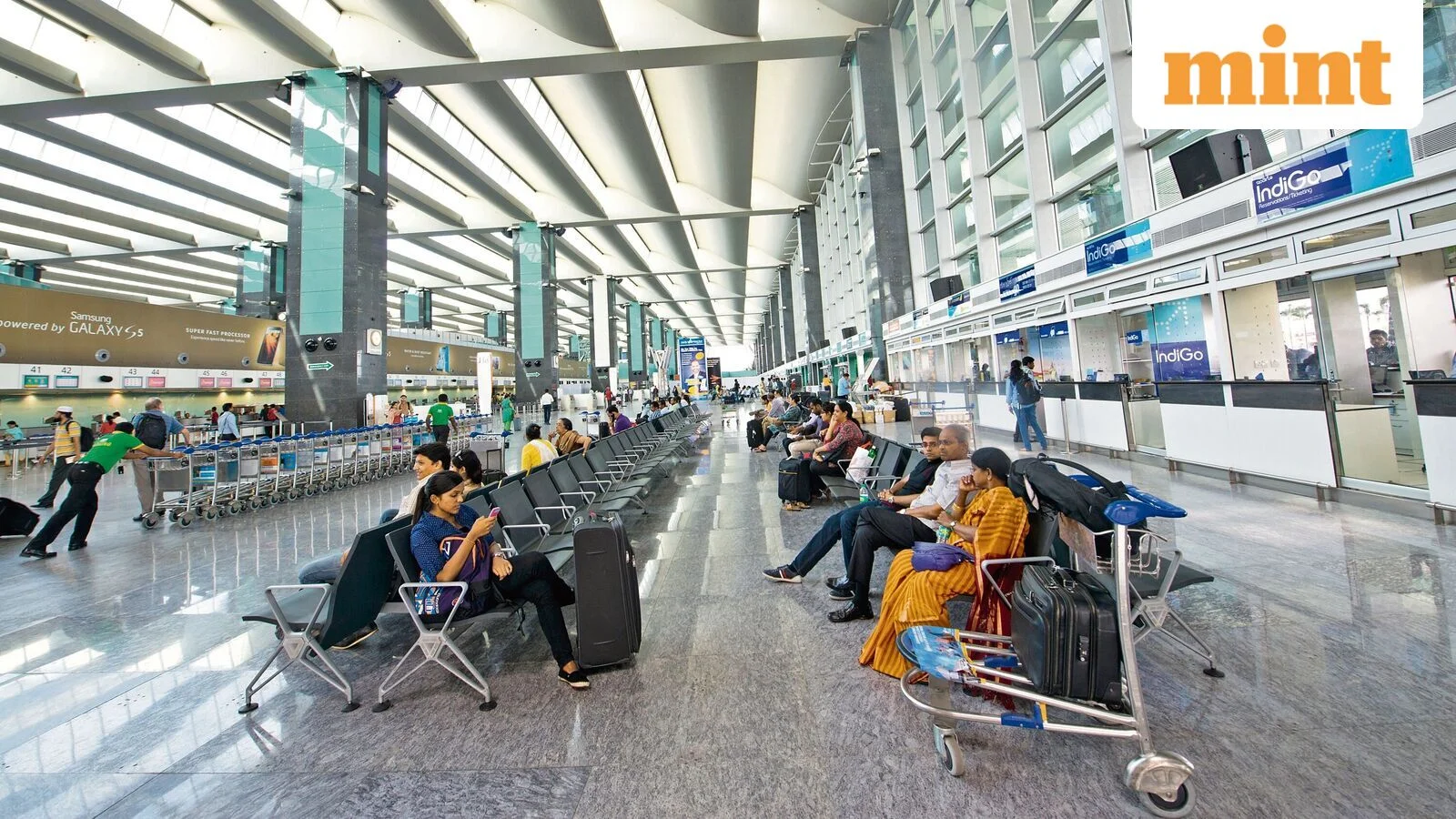
Bengaluru airport UDF falls, but new projects will add to passenger charges
New Delhi: Passengers arriving at Bengaluru airport will pay a user development fee (UDF) for the first time from September— ₹125 for domestic and ₹426 for international passengers, as the air tariff regulator, Airports Economic Regulatory Authority of India (Aera), resets the tariff structure at the country’s third largest airport.
Significantly, Aera has set a lower UDF as the starting or minimum tariff, while allowing additional charges to be added as airport expansion projects are commissioned and put to use.
This means the charge passengers pay in four out of five years will be lower, but the tariff can rise again as Bangalore International Airport Ltd (Bial) brings new infrastructure onstream. Bial, a PPP consortium, operates Kempegowda International Airport, commonly known as the Bengaluru airport.
This would be the first time that such a proposal has been cleared for any private airport operator in the country.
Key Takeaways
- Bengaluru airport will get its first-ever arrival UDF from September.
- Departure UDF cut sharply: 45.5% domestic, 33.5% international, per Aera’s order.
- Three projects, tunnel, apron, and terminal, can trigger extra charges once commissioned.
- The full build-out fee still matches today’s domestic and international UDF.
- This tariff design is a first for any private Indian airport operator.
For departing passengers, Aera has set the minimum UDF at ₹300 for domestic and ₹997 for international, down sharply from the existing ₹550 and ₹1,500, respectively. Charges are 45.5% and 33.5% lower, as per the order dated 20 August.
The new rates will apply from 1 September 2026 till 30 April 2030. From 1 May 2030 to 31 March 2031, the minimum UDF, which is being called “baseline UDF”, falls further to ₹160 for domestic departing passengers and ₹854 for international departing passengers. The corresponding arrival charges fall to ₹65 and ₹366.
In FY2025-26, Bengaluru airport saw 44.47 million passengers, up 6.2% year-on-year. Domestic passengers were at 37.24 million, up 3.3% from the previous year, and international passengers were 7.23 million, up 23.9%.
Incidentally, user development fees form a part of the passenger’s air ticket price and are charged by the airlines. The airlines then pay the respective airport operator.
Why the fee could rise again
Speaking to Mint, S.K.G. Rahate, chairperson, Aera, said: “Aera has addressed the concerns of airport operators pertaining to airport funding requirements, certainty of incremental aggregate revenue requirement (ARR) tariffs, moderation of tariff spike and overall ease of implementation of ARR framework, which have been issued in the comprehensive tariff order issued on 20 August.”
A Bial spokesperson said Aera’s order determines that the charge should be shared between arriving and departing passengers. “This does not translate into an overall increase in the base UDF.”
“Despite undertaking a massive expansion project, the combined domestic UDF under the new structure will be ₹425 compared with the existing ₹550 charged to a departing domestic passenger, while the combined international UDF will be ₹1,423 compared with the existing ₹1,500 charged to a departing international passenger,” the spokesperson said.
The significance lies in what happens alongside this lower tariff.
Aera has allowed three large airport projects to be treated separately under its incremental aggregate revenue requirement approach.
For context, Bengaluru airport had proposed over ₹18,600 crore of capex to be spread over this five-year period. The three approved projects are part of this capex plan.
As these projects are completed and brought into use, the airport operator, Bial, which is run by Fairfax, which holds a 74% majority with the Karnataka state government and the Airports Authority of India holding the remaining 26%, can recover its approved costs through additional UDF and landing charges. These would be charged in addition to the minimum UDFs or charges specified in the order.
Change is in the air
“To consider incremental tariffs on the respective projects identified under the User Pays principle,” Aera said in its order.
Put simply, passengers will initially pay the lower tariff. As new airport infrastructure comes into service, additional charges may be added, and user development fees may increase.
This is a marked departure from the existing practice, where capex plans are spread over a five-year period and factored into UDF, irrespective of delays in infrastructure commissioning.
In the case of Bengaluru airport, Aera mentioned three sets of additional charges for the three high-value projects.
The first is the Eastern Connectivity Tunnel (ECT). Aera has approved an additional UDF of ₹15 per domestic departing passenger and ₹26 per international departing passenger. Aera has considered 1 August 2029 as the effective date for calculation purposes.
But the date does not automatically mean passengers will start paying the additional UDF then.
The order says the tariff “shall become applicable only from the effective date to be notified by the Authority through an Addendum” after the airport operator submits certification confirming “completion, commissioning of the project and putting it to use for airport users.”
The second project is the T2 Phase 2 apron. Aera has approved an additional ₹20 domestic departure UDF, with no incremental international UDF. The calculation date is again 1 August 2029.
The largest addition comes with the T2 Phase 2 terminal.
The tariff regulator has approved an incremental UDF of ₹166 for a domestic departing passenger, ₹70 for a domestic arriving passenger, ₹173 for an international departing passenger and ₹73 for an international arriving passenger. The calculation date for this project is 1 May 2030, again subject to the project being completed, commissioned and put to use.
Aera reins in rising tariffs
A basic calculation shows domestic departing passengers will pay ₹300 from September 2026. If the ECT and T2 apron are commissioned on time and their incremental tariffs become applicable, another ₹35 could be added— ₹15 for the tunnel and ₹20 for the apron.
After May 2030, however, the scheduled base UDF falls to ₹160. If all three projects are commissioned and their incremental tariffs apply, the domestic departure UDF would amount to ₹361.
The same principle applies to arriving passengers and even international departures and arrivals.
So even after the major expansion projects are brought into the tariff structure, the resulting UDF would remain below today’s ₹550 domestic and ₹1,500 international charges.
Aera has also restricted the scope of the incremental mechanism. The order states: “No incremental tariff shall be applicable apart from User Development Fees and landing fees.”


