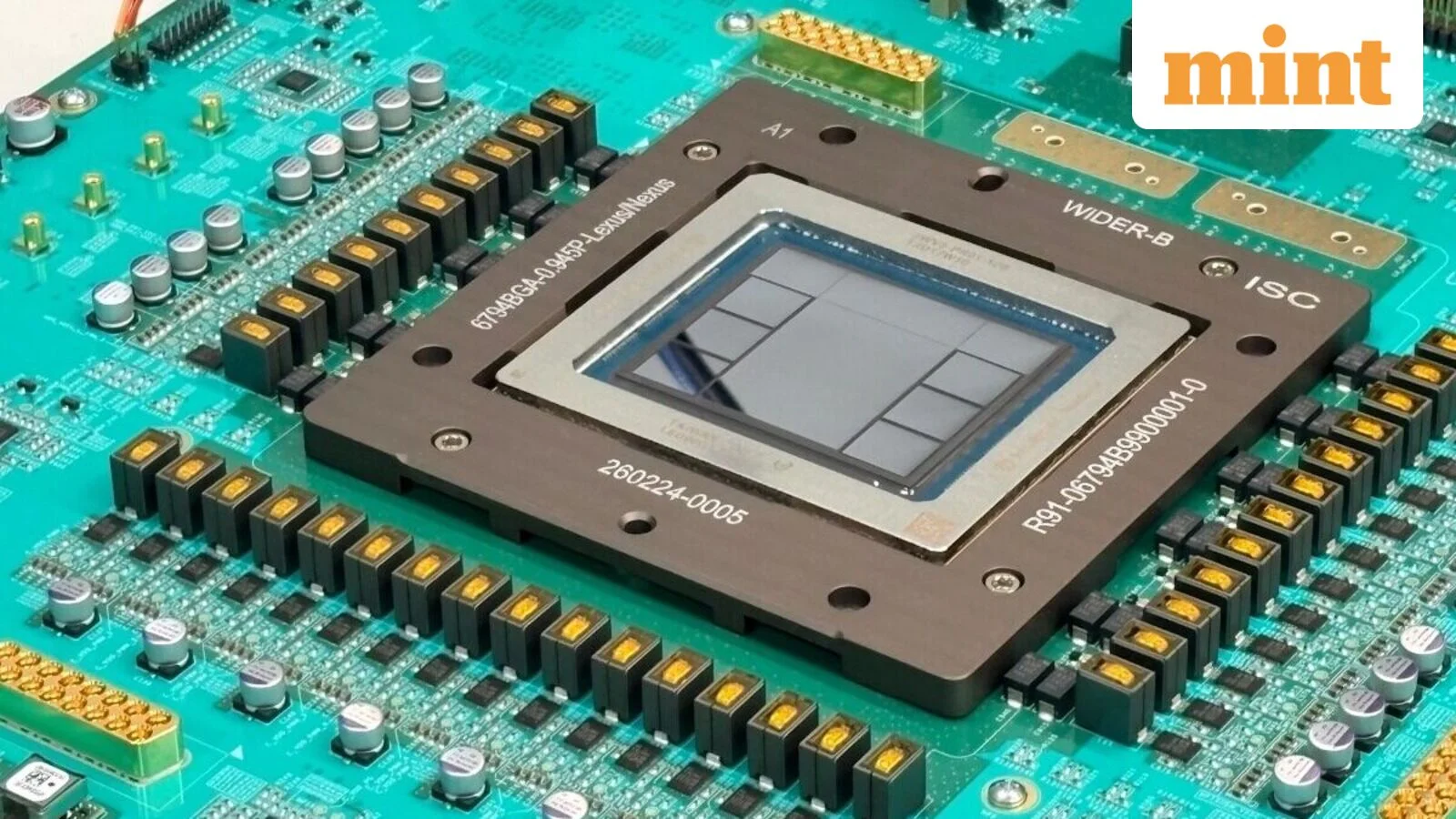
OpenAI’s Jalapeño chip claims major AI speed boost: What to know
OpenAI has shared new performance results from Jalapeño, its first custom inference chip, saying the processor can deliver more AI work per watt while also reducing response times.
The chip is designed specifically for AI inference — the stage where trained models generate answers, rather than the training process used to create those models.
OpenAI says Jalapeño is designed as part of a broader system combining chips, memory, networking and software, rather than treating the processor as a standalone piece of hardware.
The company plans to begin deploying Jalapeño in its computing infrastructure by the end of 2026, with second- and third-generation chips already in development.
What is OpenAI’s Jalapeño chip?
Jalapeño is a custom accelerator developed by OpenAI primarily for serving AI models quickly and efficiently.
AI companies currently rely heavily on commercial accelerators, particularly GPUs, to run models. OpenAI says designing its own silicon allows it to optimise hardware around the specific characteristics of modern language models and AI agents.
The goal is straightforward: generate more useful AI output using less electricity while reducing the time users wait for responses.
OpenAI says Jalapeño combines higher throughput with lower latency, avoiding a trade-off that it says is common in existing systems.
What does the chip’s performance mean?
OpenAI tested Jalapeño on three public models:
Across the three models, OpenAI claims Jalapeño achieved:
1.5 to 1.9 times more AI work per watt at peak throughput
1.7 to 3.6 times lower end-to-end latency
2.1 to 4.1 times higher performance for highly interactive workloads
On Kimi K2.5 1T, the largest public model in the test, OpenAI said Jalapeño delivered about 1.5 times higher peak performance per watt and 3.4 times lower end-to-end latency than the comparison system.
These are OpenAI’s own benchmark results, so they should be viewed in the context of the company’s testing methodology and comparison systems.
Why does inference speed matter?
For a conventional chatbot, faster inference means a response can appear more quickly.
But the impact could be much greater for AI agents, which can perform many actions sequentially.
What makes Jalapeño different?
OpenAI says the chip was designed around the different phases of AI inference.
During prefill, the system processes the user’s prompt and performs relatively compute-intensive work.
During decode, the model generates the response token by token. This phase is more constrained by memory bandwidth.
There is also a third challenge: communication.
When data has to move between different processors or memory resources, processing units can spend time waiting rather than performing useful work.
OpenAI says Jalapeño attempts to address these bottlenecks by keeping model information, including the KV cache, close to where it is needed.
Why networking is part of the chip strategy
OpenAI is not presenting Jalapeño simply as a faster processor.
The company says the network is integral to the architecture, allowing workloads to remain within a connected system and reducing unnecessary movement of data.
That matters because large AI models can contain hundreds of billions or even trillions of parameters. Running them efficiently can require distributing work across multiple chips.
Reducing communication between those chips can therefore improve both speed and energy efficiency.
OpenAI describes the resulting system as a more balanced accelerator that can handle both prefill and decode workloads.
OpenAI says AI helped build the chip
One of the more unusual aspects of Jalapeño’s development is OpenAI’s claim that AI itself played a direct role in designing the processor.
The company says AI tools helped engineers explore different implementations, shorten design and verification cycles and optimise arithmetic circuits.
OpenAI says the team went from initial design to tapeout in nine months.
“Tapeout” is the point at which a chip design is finalised and sent for manufacturing.
The company also says AI helped optimise software for the processor after the hardware was designed.
Is OpenAI replacing Nvidia?
No.
OpenAI explicitly said it will continue deploying accelerators from Nvidia and other partners for both training and inference.
Jalapeño is therefore better understood as an additional source of computing capacity rather than an immediate replacement for commercial GPUs.
The strategic significance is that OpenAI would have greater control over part of its infrastructure stack and could tailor future hardware more closely to its own models and workloads.
What’s next for Jalapeño?
OpenAI says Jalapeño is the first generation of a multigenerational hardware roadmap.
Gen 2: Already deep in development
The company plans to begin deploying Jalapeño internally by the end of 2026.
Before large-scale deployment, OpenAI says it is continuing production qualification, software development and performance testing across additional models.


