
CJP back for Jantar Mantar 2.0. Yet Rahul Gandhi’s street offensive stands out
In back-to-back meetings of the Congress Working Committee and the INDIA bloc last fortnight, Rahul Gandhi had one message: let’s fight to the finish. And this week, Gandhi followed up his message on the ground.
From charting out flash protests, entering into scuffles with the police, climbing atop barricades for visual effect, and courting arrest, the Leader of the Opposition (LoP) was at the forefront, leading the campaign demanding scrapping of the SIR and sacking of Chief Election Commissioner (CEC) Gyanesh Kumar.

So much so that some of the INDIA bloc allies and, ironically, a section of his own party MPs felt Gandhi and his sister and Lok Sabha MP Priyanka Gandhi Vadra were turning the protest and the cat-and-mouse game with the Delhi Police into a “sibling show.” Gandhi and his sister were at the centre of action on the streets of Delhi for four days in a row. It is not that Gandhi is redefining his image as an agitator or a street protester. He has had far too many launches and relaunches over the years.
In this season of street protests, the LoP perhaps did not want to do catching up for the second time. And that too on an issue which he had been flagging for close to two years, especially after the Maharashtra Assembly elections. Those close to him say Gandhi genuinely believes that the electoral system is rigged in favour of the BJP. Many within his party and many in the Opposition did not share his angst all this while. He, however, kept targeting the Election Commission (EC) and the CEC. Post-SIR, the INDIA bloc parties are now on the same page.
“See, Rahul was the first mainstream Opposition leader who called for the resignation of Dharmendra Pradhan as Education Minister,” said a senior Congress leader. “He demanded the minister’s resignation in the middle of May. The Cockroach Janta Party (CJP) was not in the picture then. But the inertia on the part of the Congress meant the demand remained only on paper. Much like the BJP and the government, we too underestimated the Jantar Mantar protests initially.”
A subtle shift
Another Congress leader said, “Our student and youth wings should have been on the streets. To be fair, they did some protests, but we have to admit that there is a difference between a political protest and a protest which the CJP led … new outfit, new leaders, there was a freshness in terms of slogans, faces, medium, reels, and all, and it clicked. But Jantar Mantar reinforced the power of street protests in a democracy.”
Gandhi’s politics too underwent a subtle shift since the Delhi Police’s July 20 crackdown on students and youth on the first day of Parliament’s Monsoon Session. The flash protest outside the Prime Minister’s residence the following day; the day-long dharna at the Parliament Street police station in August to force the police to register an FIR in connection with pellet injuries suffered by a 19-year-old student during the July 20 protest; and inviting the faces of the movement to 10, Janpath (his mother Sonia Gandhi’s residence) and meeting the media later, Gandhi engaged with the Gen-Z leaders while maintaining a distance from the CJP. He also created a space for himself in parallel with the Chhatron ki Goonj student interaction programmes.
The conventional wisdom then was that he, or for that matter the Congress, should vie to take credit or ownership of the NEET protests at Jantar Mantar, which resulted in the resignation of Pradhan. At the same time, the party was not keen to be seen as backing the CJP or having any association with it. The mood more or less remains the same.
Full Coverage: CJP’s October 10 Delhi Protest
The CJP, too, is perhaps in no mood to engage with the Congress. The Abhijeet Dipke-led outfit and the leaders of Left students’ unions have given a joint call for street protests on October 10. While the NSUI, the Congress’s student outfit, was not consulted by the CJP or called for the joint press conference, sources said a call went to the NSUI leadership from one of the Left student outfits urging them to be part of the protest. The NSUI has decided to open some sort of a helpline to support the students arriving in Delhi for the protest. Sources said both the NSUI office and the AICC headquarters will remain open for students.
Many leaders of the INDIA bloc believe the aggression shown by the Gandhi siblings throughout the week was to ensure that, unlike the NEET issue, the Congress (read Gandhi) took complete ownership of the campaign against SIR and CEC Kumar. “Rahul and Priyanka have planted the Congress flag firmly on the CEC issue. Iss mudde par humne apna jhanda gaad diya hai,” a leader said. Gandhi, in a way, took the centre stage. The party believes that it was the LoP, after all, who first flagged discrepancies in the electoral rolls.
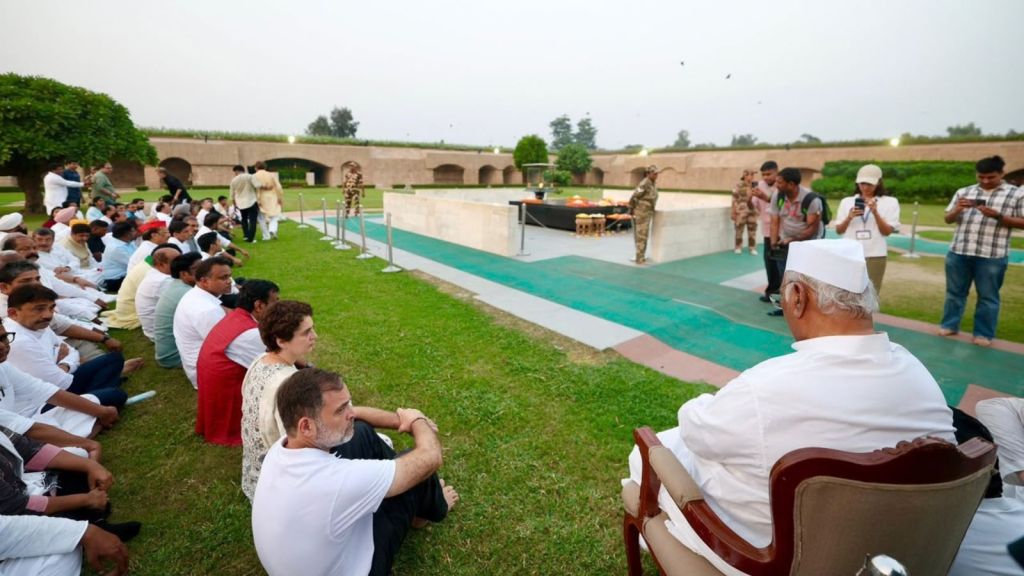 Rahul Gandhi and INDIA bloc MPs sit in silent protest at Raj Ghat over demands that CEC Gyanesh Kumar resign.
The crusader-politician
In his initial years in politics, Gandhi consciously tried to build an image of a crusader-politician. There was an unsuccessful attempt to project him as an outsider who was agitated with the way the system — both within the Congress and the UPA government — was working. Flashes of this crusader politics were visible in Niyamgiri, Odisha, in 2010, where anti-mining protests were going on, and in Bhatta Parsaul in Uttar Pradesh during anti-land acquisition protests the following year.
Much like his flash protests this week, Gandhi famously rode pillion on a motorcycle, giving the Noida district administration a slip and reaching Bhatta-Parsaul in Greater Noida around daybreak to meet protesting farmers.
He also rolled up his sleeves some years later and symbolically tore to shreds an ordinance the Manmohan Singh government had brought to protect convicted lawmakers and famously declared power as poison at the Jaipur chintan shivir of the Congress. Casting Gandhi — whose father, grandmother and great-grandfather were all prime ministers — as an angry outsider, however, did not work. And it was never supposed to. And once in Opposition came another phase where he developed the reputation of being a shoot-and-scoot leader.
His critics, both in-house and outside, often derided his frequent foreign visits. Many felt he should refrain from indulging in theatrics — Congress leaders could only squirm when he hugged Prime Minister Narendra Modi in the Lok Sabha (again in a surprise move) — and bring heft and consistency to the issues that he raised.
Both Gandhi’s admirers and detractors believe that Bharat Jodo Yatra was some sort of a turning point in his politics in terms of directly engaging with people and party cadre, and made him understand the power of visuals. The last couple of months perhaps have only reinforced that belief.


