
Japan’s Prime Minister Takaichi meets with Trump as he seeks help securing the Strait of Hormuz
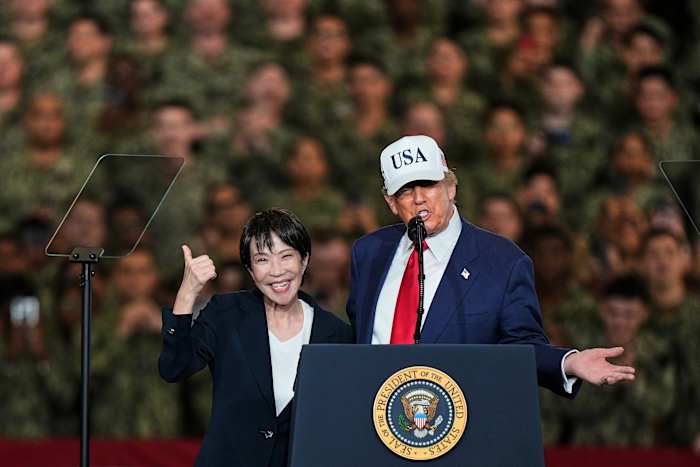
WASHINGTON – The meeting that Japanese Prime Minister Sanae Takaichi will have at the White House on Thursday originally seemed like a prime opportunity to have President Donald Trump’s ear before he embarked on a trip to China.
But now, the war in Iran and Trump’s unsuccessful call for Japan and other nations to help protect the Strait of Hormuz means the China trip has been delayed and Takaichi may be likely to get an earful.
Trump has repeatedly complained on camera and online that U.S. allies, including Japan, have rejected his request to help safeguard the critical waterway for oil and gas transport.
“In fact, speaking as President of the United States of America, by far the Most Powerful Country Anywhere in the World, WE DO NOT NEED THE HELP OF ANYONE!” Trump exclaimed on Truth Social after his initial call for help was rebuffed.
The prime minister acknowledged before she left Japan that she expects her meeting with Trump will be “very difficult.” She and her ministers have denied that Washington officially requested Japanese warships for the U.S.-Israeli operation.
Japan, a key U.S. ally in Asia, is one of the countries that Trump namechecked on Tuesday as he railed against the lack of help with the Strait of Hormuz before declaring the help wasn’t needed.
Trump is expected to put “enormous pressure” on Takaichi, said Kurt Campbell, the former U.S. deputy secretary of state in the Biden administration who is now chair of The Asia Group.
Campbell said he’s never seen a meeting between U.S. and Japanese leaders carrying such high stakes. In order to press for Japan’s interests, he said, Takaichi will want to find a way to suggest that Japan is a part of the U.S. plan in the Middle East.
“She’s going to want to come out of that as a partner in this case and realize that if she can do that, that she can translate that potentially into the president listening more to Japanese concerns about Taiwan or other issues,” Campbell said.
The constraints on Japan’s involvement in Iran include a provision in its post-World War II constitution that bans the use of force except to defend its territory. The country’s military is called the Self-Defense Force.
Christopher Johnstone, a partner and chair of the defense and national security practice at The Asia Group, said Japan could help with mine-sweeping, and has had “a small naval presence” in the region as part of an anti-piracy mission for at least a decade. But to join the U.S. mission would require Takaichi to clear “an exceptionally high bar politically to invoke collective self-defense” that has never been done before.
Takaichi wanted to focus on trade and security in the Indo-Pacific region
Takaichi, who had her first meeting with Trump in October in Tokyo, is Japan’s first female prime minister and a protégé of former leader Shinzo Abe, who developed a close relationship with Trump.
She is also a hardline conservative and longtime supporter of Taiwan whose comments about Japan’s willingness to provide military support to the island have heightened tensions with China.
Ahead of her meeting with Trump, Takaichi had sought to focus on trade, strengthening the U.S.-Japan relationship and security concerns. Japanese officials said the two sides would work to deepen cooperation in regional security, critical minerals, energy and dealing with China.
China views self-governed Taiwan, which the U.S. relies on for its production of computer chips, as its sovereign territory and has said it would take it by force if needed.
But beyond questions about helping with the Strait of Hormuz, the global implications of the Iran war have also put the Japanese leader in a tougher spot with Trump as she seeks to ensure U.S. commitment to the Indo-Pacific region.
Japan considers China a growing security threat and has pushed a military buildup on southwestern islands near the East China Sea. But the U.S. has shifted some troops stationed in Japan to the Middle East, removing a check against China’s power.
Takaichi is expected to raise concerns about troop shifts with Trump because they are coming at the same time China is launching a large number of exercises around Taiwan.
“This raises the prospect that — once again — the United States will be distracted and bogged down in the Middle East at a time when the deterrence problem in East Asia has never been greater,” Johnstone said.
___
Associated Press writer Mari Yamaguchi in Tokyo contributed to this report.
Copyright 2026 The Associated Press. All rights reserved. This material may not be published, broadcast, rewritten or redistributed without permission.


Post Comment