
How depleted soils are emptying the nutrients in our food
So why is farm land not a worthy asset anymore? Because of a vicious cycle. Sustaining a family on earnings from a small plot of land is a daunting task. Crop prices and profitability is low, so farmers have little surplus left to invest in the farm, say, to restore soil health and improve crop productivity. Meanwhile, recurring climate shocks such as a drought or a heatwave is an additional risk.
Nearly half of India’s workforce is employed in the farm sector which contributes about 15% to its national income. Given the significance of the agriculture sector, can higher public investments, in the form of research, precision equipment, irrigation support and insurance, help alleviate this pain? The budget presented last month throws up some interesting numbers.
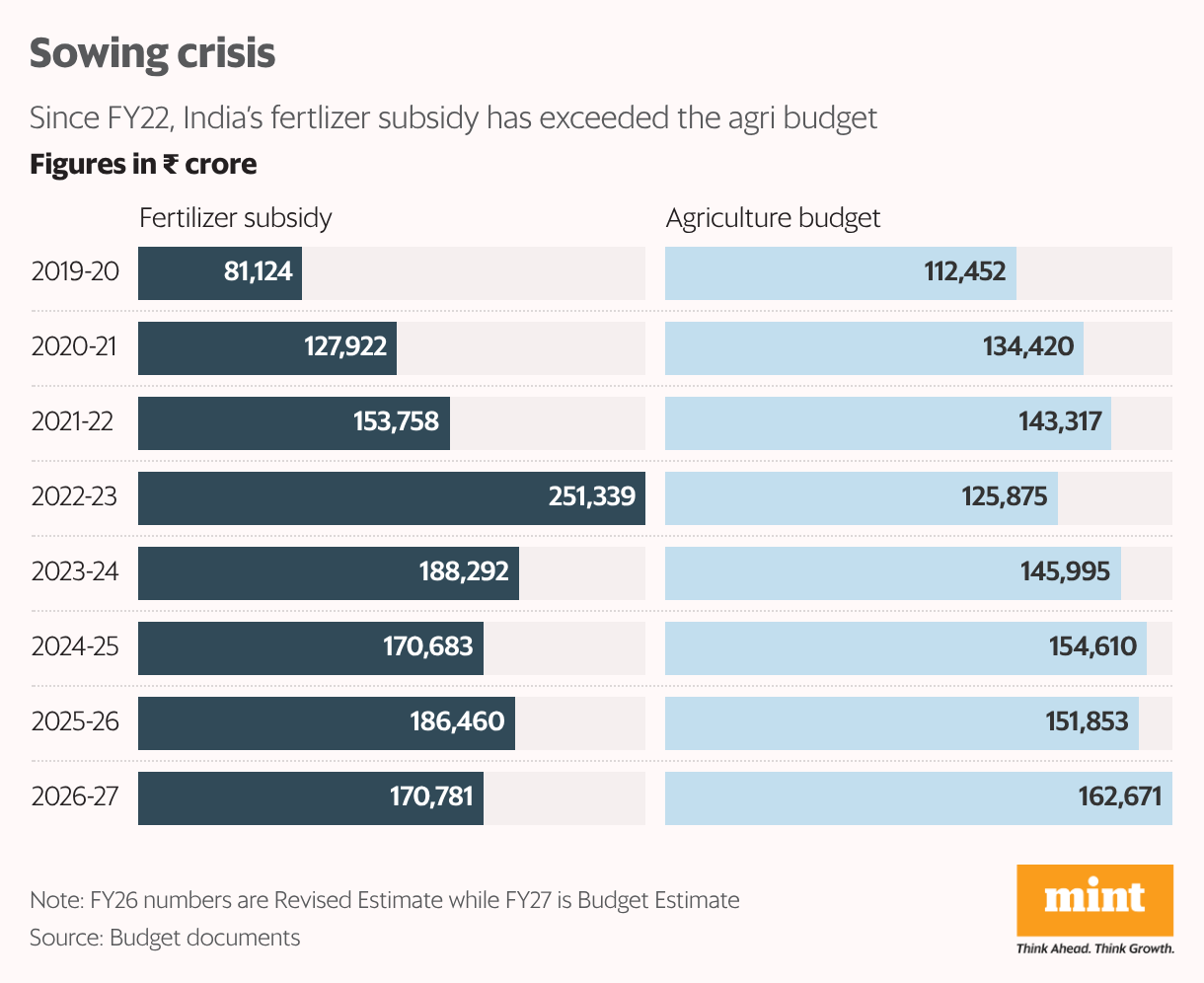
In 2025-26, the fertilizer subsidy bill alone is estimated to cost the federal government a staggering ₹1.9 trillion. This is far higher than the entire budget for agriculture (including livestock and fisheries), at ₹1.5 trillion. The government will spend ₹1.3 trillion just on urea subsidy. An inevitable outcome is that little money is left for research, insurance support, investments in agriculture related infrastructure or price support for farmers.
The crisis in fertilizers and mounting subsidies is due to the fact that India remains acutely dependent on imports—about 75% for urea, 90% for DAP (diammonium phosphate) and 100% for potash. So global shocks often lead to a spike in the subsidy bill as farmers are shielded from the price rise. For instance, in 2022-23, India spent over ₹2.5 trillion on fertilizer subsidies, the largest till date, due to the spike in global energy and fertilizer prices following Russia’s invasion of Ukraine (that year, the entire budget for the agriculture sector was ₹1.25 trillion).
Even as global prices rose, the domestic price of urea has not seen any hike for nearly two decades now. Because urea is ridiculously cheap (nearly 90% of the price is subsidy), farmers tend to over-apply urea and use less of other expensive nutrients. This imbalanced use reduces soil fertility. The excess urea used on the farm is not used by plants. It gets released into the atmosphere as nitrous oxide, a toxic greenhouse gas, with a global warming potential 272 times that of CO2.
“The scale of the problem is mind numbingly crazy…we are pouring taxpayer money into a subsidy which is literally going up in the air. Plants absorb only around 40% of the applied urea (due to falling nitrogen use efficiency). The rest damages the environment,” said Avinash Kishore, senior fellow at the Delhi office of the International Food Policy Research Institute (IFPRI). “Every year we analyse threadbare the budget for the agriculture ministry without paying attention that the largest share of the farm budget sits with the fertilizer department. That money can be spent productively for farmers in other areas.”
So why have reforms escaped the fertilizer sector? Because there is little political appetite for the risk it entails, experts say. Governments fear that any increase in the retail price of urea will stick an anti-farmer label on it and fuel protests.
Up in the air
Often, farmers do not realise they are over-applying cheap urea and that this practice is hurting their soil. Take the case of Ashok Danoda, a young farmer from Jind district of Haryana, who farms on three acres. This winter crop season, Danoda applied two and a half bags of urea (each weighing 45 kg retailing at ₹267) per acre on his wheat crop. This is at least 30% more than the recommended dose. Danoda also does not know his soil parameters, as to which macro or micro nutrients are deficient.
Under the Soil Health Card Scheme, the government periodically tests soil samples to nudge farmers to use nutrients correctly. “But in my village, only one sample was taken and the results were extrapolated for all farmers,” Danoda said.

View Full Image
Last year, he added, farmers had a hard time procuring urea and DAP, often standing in queues for hours or visiting input shops repeatedly, due to uneven supplies amid a spike in demand. The industry estimates that urea consumption may touch a record 40 million tonnes in FY26.
India’s soils, the very foundation of its agriculture and food systems, are under a severe, escalating strain, said a research report on soil health and fertilizer use published last month by the Delhi-based think tank, ICRIER. Only about a quarter of Indian soils have sufficient soil organic carbon (SOC) which is a critical indicator of soil structure, microbial activity and nutrient uptake.
Indian soils also suffer from a deficiency of micronutrients like sulphur, iron, zinc, and boron. The nutrient imbalance is a result of decades of intensive cropping (beginning with the green revolution years in 1960s), heavy reliance on nitrogen-heavy fertilisers like urea, and insufficient application of organic matter.
This decline has consequences beyond just soil fertility, the report said. Poor soil health is intrinsically linked to the nutritional quality of food. Crops grown on nutrient-deficient soils tend to be lower in essential micronutrients such as zinc and iron.
The ICRIER study also revealed a lesser-known aspect. Despite over-use of nitrogenous fertilizers like urea, over 90% of soils are deficient in nitrogen. This is because low organic carbon in Indian soils reduces its nutrient holding capacity. This means the nitrogen in urea is not taken up fully by crops or retained in the soil. Rather nutrients worth thousands of crores leaches to the ground water below and are released into the atmosphere above.
Nitrous oxide emissions from soils contribute to over a fifth of all greenhouse gas emissions from agriculture in India, said a 2026 report on Net Zero pathways by the federal think tank Niti Aayog. As per the report, agricultural soil emissions in India rose by about 7% between 2011 and 2019, parallel to the consumption trend of nitrogenous fertilizers which grew by 10% during this period. Consumption of fertilizers grew because of higher crop intensity and improved access to irrigation. Further, declining nitrogen use efficiency meant farmers applied higher quantities of nitrogen per unit of land to get the same yield.
Growing imports
Data from the Fertilizer Association of India (FAI), the industry lobby, show that the country’s dependence on imports grew last year as domestic production was unable to meet the surge in consumption. Urea imports rose by 120% year-on-year amid a 3.7% drop in domestic output (April-November, FY26). Similarly, import of DAP grew by 54%. In a statement, FAI said that fertilizer imports into India have turned ‘structural’ and are ‘not supplementary’ in nature.
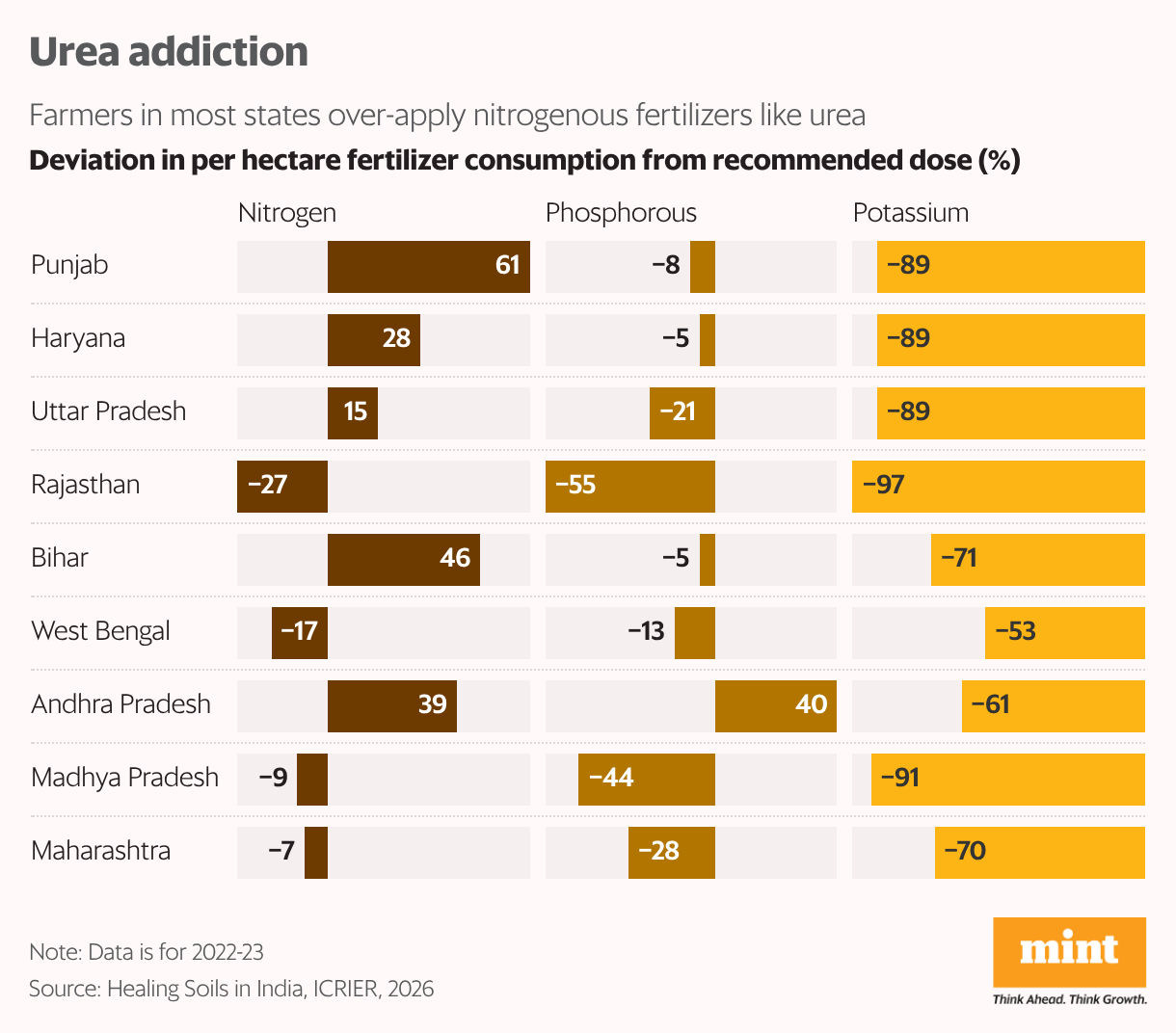
The least one can do in such a situation is apply this expensive farm input judiciously. But since retail prices of urea do not reflect the true cost of the product, farmers over-apply urea at the cost of other nutrients. As per data cited in the ICRIER report, excess use of urea ranges from 61% in Punjab to 46% in Bihar and 54% in Telangana.
A failed experiment?
A nano urea product launched in 2021 by Indian Farmers Fertiliser Cooperative Ltd (Iffco), a fertilizer manufacturer and farmer’s coop, had raised hopes of attaining ‘atmanirbharta’ (self-sufficiency). The manufacturer claimed that a 500-ml bottle of nano urea, priced at ₹225, will be as effective as a 45-kg bag of urea.
The fertilizer ministry had estimated that a 25% replacement of granular urea with liquid nano urea will save the exchequer about ₹20,000 crore every year in subsidies. But the product failed to convince farmers, and fertilizer subsidies climbed higher.
Farmers are still buying the product because a bottle of nano urea is often forced on them for every 3-4 bags of granular urea they purchase. To make matters worse, a field study by the Punjab Agricultural University, published in 2024, reported a significant drop in rice and wheat yields upon use of nano urea. In its 2020-21 annual report, Iffco had described nano urea as the ‘innovation of the century’. On the ground, it could achieve little.
So, what can India do to restore the health of its soils and rationalise public spending in agriculture? India has already undertaken some steps like neem coating of urea, Aadhaar-linked point of sale verification to prevent diversion of subsidised urea for industrial use.
India has already undertaken some steps like neem coating of urea, Aadhar-linked point of sale verification to prevent diversion of subsidised urea for industrial use.
But these measures do not alter the core economic signal that farmers face when choosing nutrients, the Economic Survey released last month said. “As long as one nutrient is vastly cheaper than others, its overuse is structurally embedded, regardless of monitoring or enforcement.”
The survey recommended that the government modestly raise the retail price of urea while transferring an equivalent amount directly to farmers’ accounts on a per-acre basis. This will provide farmers who over use urea an incentive to use the cash transfer to buy other nutrients.
A rationalisation and gradual increase in urea prices is long overdue, said Suresh Kumar Chaudhari, director general of FAI, the industry body. “In addition, farmers need to be given proper awareness and advisories to improve soil nutrient balance. The government can also encourage adoption of natural farming practices (to improve soil health) to lower use of chemical fertilizers.”
Chaudhari also highlighted another reality which pushes farmers to grow more cereal crops that require more fertilizers (due to assured purchases at a support price for rice and wheat, and maize used to produce ethanol for fuel blending). The moment farmers get access to irrigation, they switch from pulses and oilseeds (which require less fertilizers) to cereal crops. The addiction and demand for cheap urea, is therefore linked to the perverse incentive to grow more cereals.
That urea prices need to be raised to reflect the actual cost of production is a no-brainer, though it is fraught with a high political risk, said an executive from a fertilizer company. A practical way to do this would be by triangulating data from different sources: from Aadhaar-linked sales, and farmer data from the PM-Kisan portal (used for cash transfers) and the crop insurance database.
The Economic Survey also suggests a similar approach. But this leads to two problems, said Avinash Kishore from IFPRI, quoted earlier. First, the reliability of cash transfers is low because they are often not indexed to inflation (which means the transferred cash may fall short while purchasing fertilizers). Second, India is yet to find a way to transfer cash to the vast pool of tenant farmers who actually grow crops (since most tenancies are informal).
“I believe soil is a living thing. The health of soil, plants, animals, people and the environment is one and indivisible,” were the wise words of Rattan Lal, the 2020 World Food Prize Laureate. Lal’s pioneering work changed the scientific understanding of soils and the importance of soil organic carbon. “If soils are not restored, crops will fail even if rains do not…and humanity will suffer even with great scientific strides,” Lal had warned. That’s a strong enough call for India to fix both its fertilizer subsidies and depleted soils.
Key Takeaways
- India’s staggering fertilizer subsidy now exceeds the entire agriculture budget.
- It drains vital funds that could otherwise support irrigation, modern research, and essential farming infrastructure.
- Cheap urea encourages chronic over-application.
- This leads to severely degraded soil health, toxic greenhouse gas emissions, and nutrient-deficient crops that threaten the long-term sustainability of Indian food.
- Political aversion—governments fear that any increase in the retail price of urea will stick an anti-farmer label on it and fuel protests—are stalling necessary reforms.
- A rationalisation and gradual increase in urea prices is long overdue.
- The Economic Survey recently recommended that the government modestly raise the retail price of urea while transferring an equivalent amount directly to farmers’ accounts on a per-acre basis.


Post Comment