
Mint Explainer | What India’s uneven EV adoption means for the next phase of green mobility
A report by industry body Confederation of Indian Industry (CII) and consulting firm Kearney evaluates penetration trends, regional variation and infrastructure readiness to assess what is working and what remains constrained. Mint explains what the uneven adoption means for the next phase of green mobility.
Is transportation a major source of emissions?
Transport accounts for a significant share of India’s energy-related carbon dioxide emissions, contributing around 12-13%. Just road transport is responsible for about 90% of that share.
Medium and heavy commercial vehicles, while comprising less than 5% of the fleet, contribute roughly 40% of all road transport emissions. The broader vehicle population exceeds 350 million, with about 250 million believed to be in active use. Transport emissions have grown at around 6%–7% compound annual growth.
Clearly, decarbonizing the sector can have a strong impact on reducing emissions overall. Adoption data now shows that EVs are beginning to shape India’s emissions profile in small but visible ways. However, that impact is concentrated in specific segments rather than evenly distributed across the transport system.
Where are EVs scaling up?
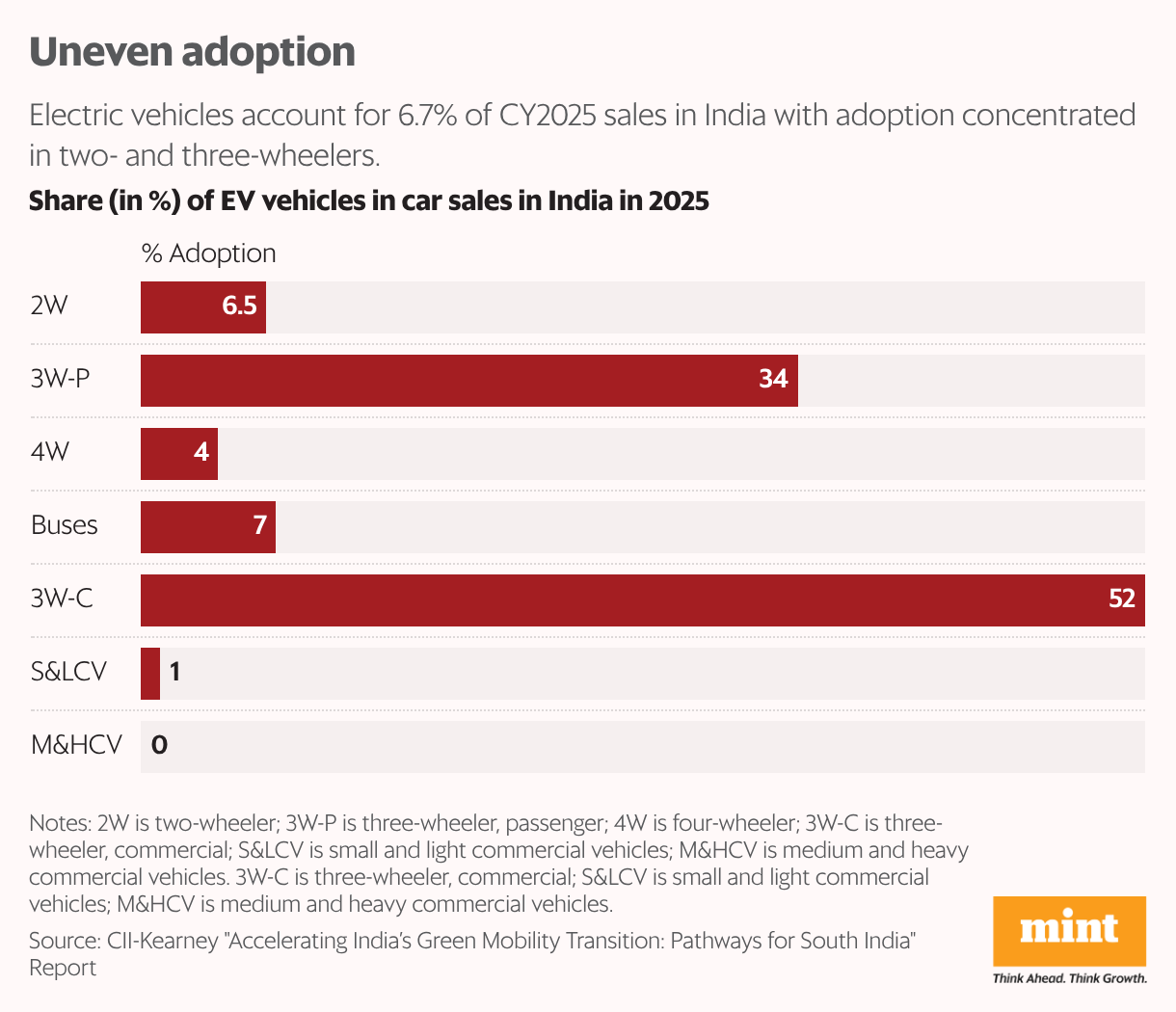
Electric vehicles accounted for 6.7% of total sales in 2025. EVs made up 6.5% of two-wheeler sales and 52% of the commercial three-wheeler segment. For buses and four-wheelers, national penetration stood at 7% and 4% respectively, while clean mobility penetration in medium and heavy commercial vehicles was effectively zero.
The divergence reflects differences in policy support, infrastructure readiness and operating economics. Commercial three-wheelers have scaled the fastest due to high utilization and a 9-20% lower total cost of ownership. Buses present a different dynamic. Their 7% penetration reflects government procurement programmes such as PM-eBus Sewa and structured fleet deployment that allows charging to be organized within transport systems.
Two-wheelers, which have a penetration level slightly lower than buses, benefit from simpler technology, smaller battery requirements and lower reliance on public charging, making it more viable. Private four-wheelers, by contrast, depend heavily on distributed public charging networks and face affordability constraints. Where utilization, charging access and economics align, adoption accelerates. Where one of these conditions lags, uptake remains limited.
How are infrastructure constraints hurting EV adoption?
Early EV promotion in India focused on demand incentives. The government’s cumulative investment in clean mobility incentives exceeded ₹82,000 crore, with ₹840 crore directed specifically toward charging infrastructure under Faster Adoption and Manufacturing of Electric Vehicles (FAME) and more than ₹45,000 crore committed to manufacturing incentives.
However, infrastructure has not scaled uniformly across regions or segments. The report highlights charging access as a constraint in several segments, particularly for four-wheelers and buses that require a charging network dense enough for public use. Building this network involves land allocation, grid upgrades and capital coordination, all of which tend to move more slowly than demand subsidies.
Across India, government data reveals that more than 29,000 public EV charging stations had been installed by late 2025, yet this network is still far smaller than what would be needed for a rapidly growing EV base. Of these, only about 8,800 are fast chargers, with the rest slower units, reflecting gaps in both density and service speed.
A CareEdge Rating report in 2025 pointed out that there is currently only one public charging station for every 235 EVs, a ratio that can deter users and contribute to range anxiety.
In urban centres such as Delhi, the mismatch is more acute. Despite a strong EV presence and rising usage at public charging points, the capital faces a shortfall in chargers relative to demand. The Delhi government plans to add about 7,000 new public charging points and 100 battery-swapping stations in 2026 to expand access and reduce congestion at existing stations.
This uneven infrastructure build-out reinforces the broader adoption imbalance identified in the report and underscores why the next phase of India’s EV transition depends more on execution and scaling of charging networks than on demand incentives alone.
How does regional execution determine adoption outcomes?
More than 25 states have notified EV policies, covering over 90% of the vehicle market. The report shows that states with stronger execution, those that complemented central incentives with faster infrastructure rollout, permitting clarity and integration into urban planning, achieved above-average penetration.
For example, in southern India, three-wheeler EV penetration ranged from around 31% in some states to more than 70% in others by 2025. Two-wheeler EV issuance in the region was also higher than the national average. This divergence shows that uneven adoption is not only segmental but also geographic.
This regional variation matters because national targets, such as India’s goal of 30% EV sales share by 2030, will depend on whether lagging states close execution gaps.
What about the freight transport sector?
Medium and heavy commercial vehicles have proven to be the hardest segment to decarbonize. In India, these vehicles make up a small share of the total fleet but contribute disproportionately to emissions because freight movement is energy-intensive. According to the report, clean mobility penetration in this segment is effectively zero at the national level.
Part of the reason is that there is still no broadly adopted, commercially viable electric truck product for most freight use cases. While several manufacturers now offer or are developing electric freight vehicles targeting light and medium payloads, heavy-duty segments are only beginning to see viable options.
Manufacturers such as Tata Motors and Ashok Leyland have introduced light and medium electric truck models, such as the Tata Ultra T7 Electric and Ashok Leyland Boss EV range, aimed primarily at urban delivery and regional logistics.
EV-first firms like Euler Motors are producing smaller electric trucks for last-mile logistics, and companies such as Montra Electric are pushing into larger GVW electric truck platforms. These offerings signal nascent commercialization but remain limited in scale and payload for heavy or long-haul freight.
Pricing and operational constraints compound the challenge. Electric freight vehicles remain significantly more expensive than their diesel counterparts, and high-capacity charging infrastructure tailored to heavy trucks is largely absent along logistics corridors.
What next for transport sector decarbonization?
The report identifies four interdependent pillars that must move together in the next phase: technology and capability development, infrastructure creation, ecosystem strengthening and fleet renewal. Progress in one pillar without corresponding movement in the others will limit the overall impact.
For example, vehicle supply without charging access could suppress utilization. Insufficient financing mechanisms could keep fleet operators from upgrading. And without managing the legacy fleet through scrappage and renewal, gains from new sales risk dilution.
The report also highlights broader benefits if the next phase succeeds. Electrification could create about 500,000 cumulative jobs by 2030, spanning manufacturing and services. Lower oil imports could save an estimated 51 billion litres by 2035, equivalent to cumulative savings of more than $100 billion.
Heavy investment by industry players also reflects this shift. Major manufacturers and joint ventures are now committing significant capital toward new energy vehicles. Suzuki’s recent EV launch with a battery rental plan, for example, reflects experimentation with business models to reduce upfront cost barriers and signal production scale.
How to move from uneven adoption to disciplined prioritization?
In the early years, incentives and policy intent were the dominant tools. The adoption data now shows that electrification has progressed from niche to mainstream in some segments, while remaining limited in others.
It is clear that where enabling conditions come together, adoption follows. The next phase of green mobility will depend on narrowing these gaps through infrastructure build-out, regulatory refinement and targeted support for harder-to-abate segments.
India’s EV transition has moved beyond initiating change. The next phase will be defined by whether policymakers and industry can correct structural imbalances and extend progress beyond early winners.


Post Comment