
India’s top firms suffer a ₹12,000 crore labour code blow in Q3
Of India’s top 30 companies, 25 that have reported the impact of the amended labour regime suffered a nearly ₹12,000-crore blow to their December quarter profits, a Mint analysis showed. The rules mandate higher social security contributions from both employers and employees, and also increase retirement benefits.
While the provisions stemming from the labour code accounted for just 7.70% the 25 companies’ aggregate Q3 profit, this won’t be a one-time cost.
Consulting firms caution that wage bills are set to increase even as India Inc.’s margins are under pressure amid macro and global uncertainties. The collateral damage could be lower salary hikes in the upcoming appraisal season.
“The hit was expected due to the gratuity impact now required to be calculated on ‘wages’—these are now the provisions that the companies have estimated. Labour-intensive sectors like IT (information technology) and some manufacturing (e.g. apparel and footwear) will see a larger impact than others,” said Alok Agrawal, partner for Tax at Deloitte.
“Some of the companies may have over-provided (based on their earlier compensation structure) and may have subsequently realigned their structures,’ he said. “Also, the recurring increase in gratuity will play out in the wage bills of companies in the coming quarters.”
Under India’s new labour codes, wages must account for at least 50% of remuneration, increasing gratuity and other statutory payouts, such as the provident fund.
The companies have reworked the costs of gratuity and leave encashment due to the broader definition that came into force in November. And, employees may even see a slight reduction in take-home pay if the overall cost-to-company remains unchanged.
IT sector worst hit
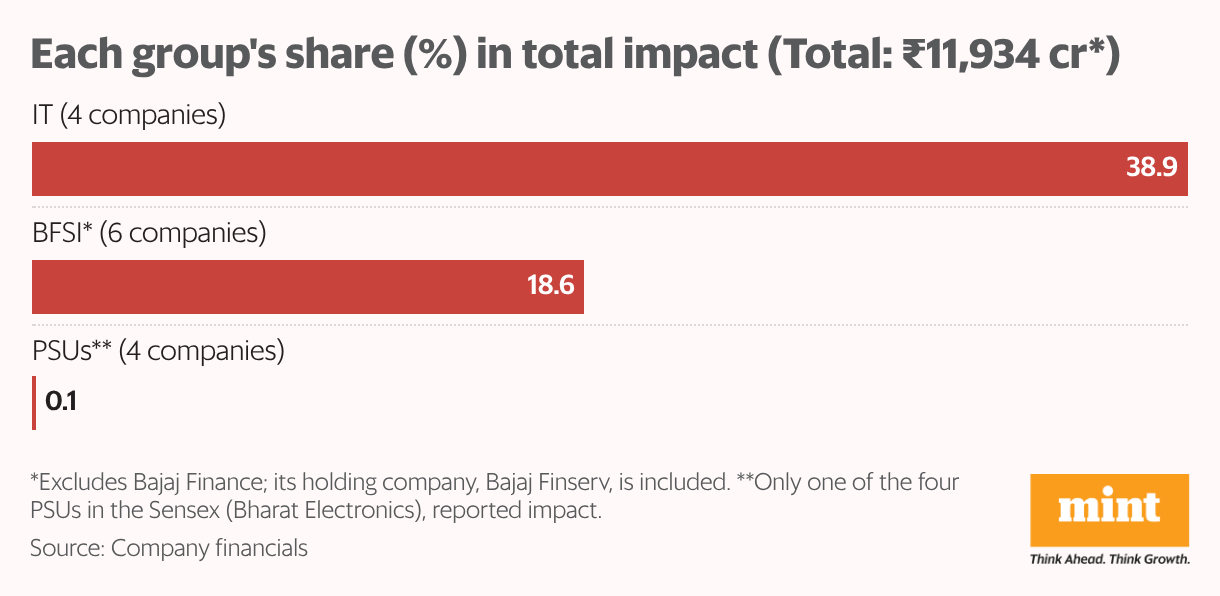
Four IT services majors, TCS, Infosys, HCL Technologies and Tech Mahindra, accounted for about 39% of the total hit from the labour code in the 25 companies. Banking, financial services and insurance (BFSI) firms contributed 19% to the overall impact.
Among the four public sector undertakings in the index, three did not see any impact from the new labour laws.
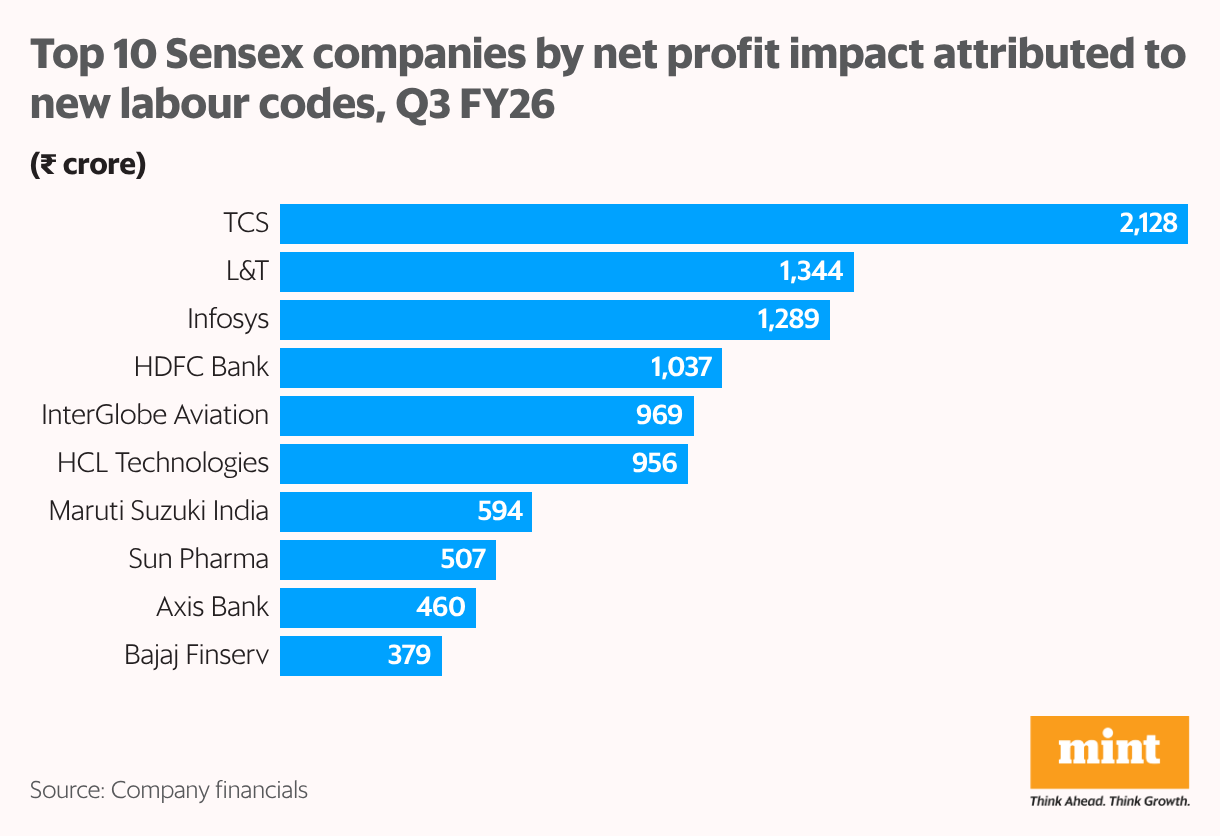
TCS, India’s largest software services provider, recognized a ₹2,128-crore impact in the December quarter, while its second-largest peer Infosys Ltd accounted for a dent of ₹1289 crore. Third-placed HCL Technologies Ltd set aside ₹956 crore, while Tech Mahindra Ltd made a provision of ₹272.4 crore.
In an analyst call in January, TCS offered the breakup of the impact recognized in their financial statements: ₹1,800 crore in gratuity and ₹300 crore in leave liability.
These are one-time costs related to past employee salaries. Samir Seksaria, chief financial officer of TCS, told analysts during a post-earnings call, “We expect the ongoing impact to be minimal, around 10 to 15 basis points.”
“In high-paying sectors such as IT and IT-enabled services, there has been a trend where the basic salary component often accounts for less than half of the total remuneration,” said Akhil Chandna, partner and global people solutions, Grant Thornton Bharat. “As a result, these industries are more impacted as compared to sectors where employees’ basic pay and dearness allowance together exceed 50% of the total remuneration, such as those employing a significant proportion of blue-collar workers.”
India’s largest carmaker Maruti Suzuki India Ltd booked a one-time provision of ₹593.9 crore on account of the labour codes. Chief financial officer Arnab Roy told analysts that there is “no significant recurring impact” and that it’s predominantly past service costs that have been accounted for.
Among lenders, HDFC Bank Ltd’s CFO Srinivasan Vaidyanathan said during the post-earnings call that the ₹800-crore impact recognised is a high-level estimate, not a precise or final number.
“It is an estimate given whatever information that we have,” he said. The calculation has been done through a “scientific actuarial process,” following a formal valuation method to assess long-term employee liabilities. But even that process is based on assumptions.
For listed companies, the majority of the impact has been reported in Q3, but the fourth quarter may see a marginal impact due to “true-up of provisioning as per the new wage definition”, according to Chandna of Grant Thornton Bharat. “For subsequent quarters, the one-time impact would not be significant.”
Modest hikes
Still, talent and recruitment consultants expect increased labour code payouts to shrink increments in the short term.
India Inc is planning to roll out a modest increment of 8.5-9.5% as companies factor in the impact of the labour code and almost stagnant inflation. Like last year, 2026 is expected to be an employer’s market, with firms working through the impact of artificial intelligence and the crests and troughs of global uncertainty.
Anustup Chattopadhyay, associate partner at Aon Talent Solutions, said, “The FY26 hikes could get impacted because of the hit that the firms have taken, but in the long run, these codes will improve the social security of both organized and unorganized sectors.”


Post Comment